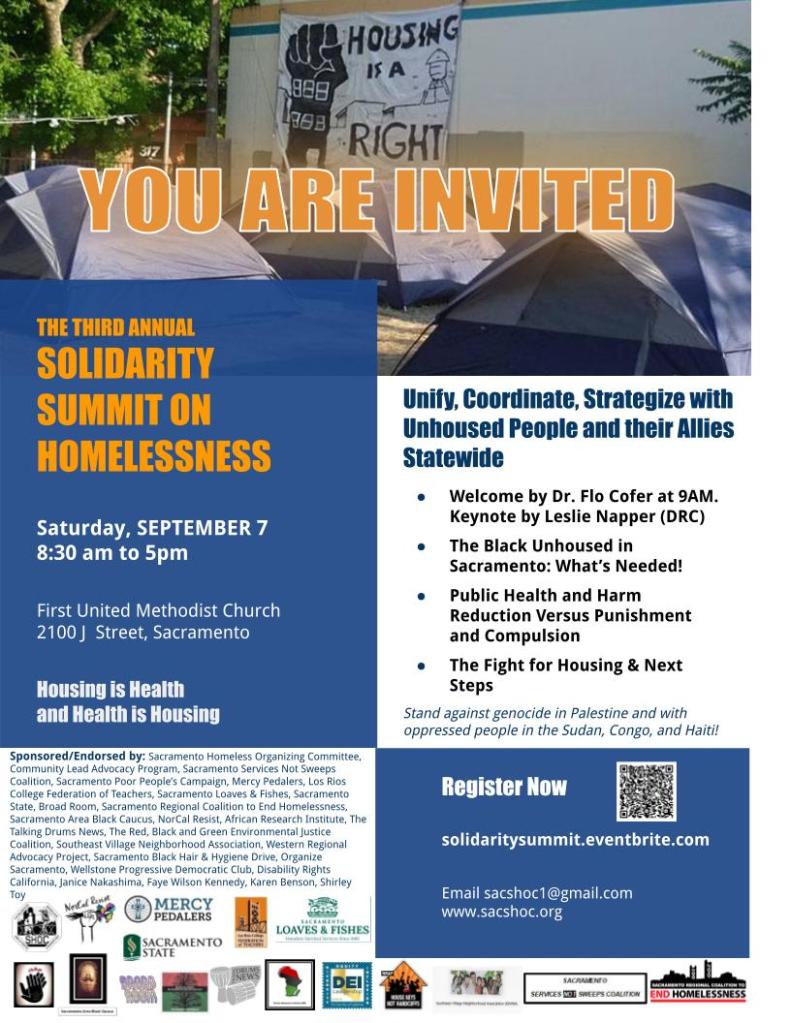
Join us for the Fourth Annual Solidarity Summit on Homelessness, Saturday, September 13, 10am to 4pm at the 1st United Methodist Church, 2100 J Street in Sacramento!
Sponsorships and Donations are welcome and will be listed on future event literature! DONATE (Include note “Summit” with donation)
The Fourth Annual Solidarity Summit on Homelessness is scheduled for Saturday, September 13, hosted by the Sacramento Homeless Organizing Committee (SHOC) and the Sacramento Poor People’s Campaign, with many other community sponsors. The event will be held at the First United Methodist Church, located at 21st and J streets in Sacramento, from 10:00 a.m. to 4:00 p.m.
This all-day event provides a space for the movement to gather, network, and explore the different organizations that involve and assist our unhoused and low-income community.
This year we will provide a mini-spa for selfcare, legal clinic referrals and information, art activities for children, and music! Our central focus will be a teach-in facilitated by Dr. Flo Cofer and members of the Solidarity Summit Core Planning Team and others. “Organizing For Survival and Building Community” will address the need for organizing from a number of different perspectives, including voting and running for office, and how that relates to building a movement and confronting fascism.
This year, as we have done every year, we will stand against the attacks on our Black, migrant, indigenous, and undocumented community, the attacks on the social safety net (including MediCal and Food Stamps (SNAP)), the ongoing genocide in Palestine, and with oppressed people all over the world who are bearing the brunt of US militarism and aggression, as in the Sudan, Congo, and Haiti.
As it becomes available, we will share additional information about the program and how we can assist with shuttling from local encampments or travel arrangements. Last year, we had over 100 attendees!
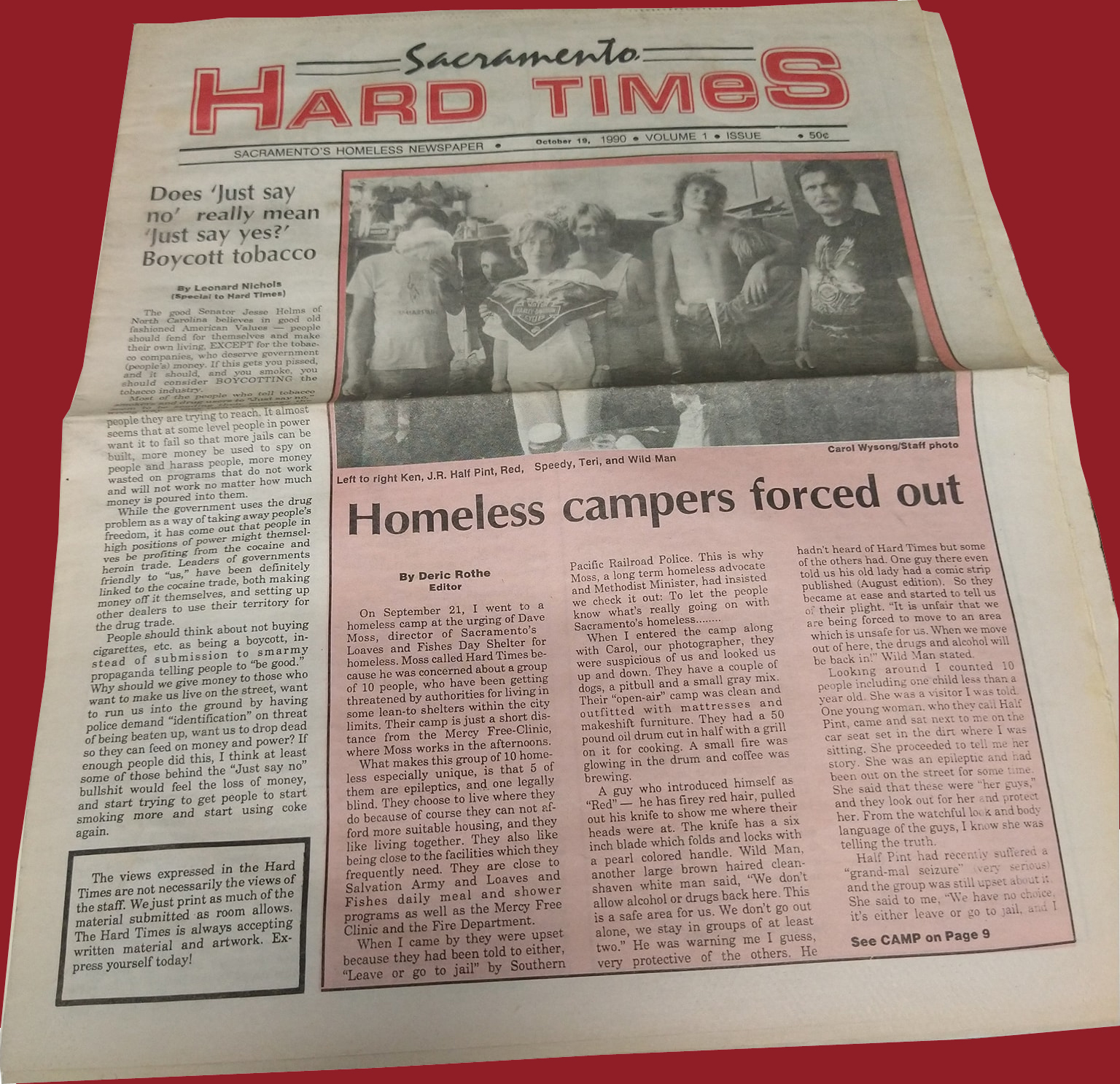
Going through old SHOC archive files I came across several Hard Times street newspapers, published in Sacramento in the early 1990’s. 50 cents! I took photos of each page and have compiled the photos into six issues:
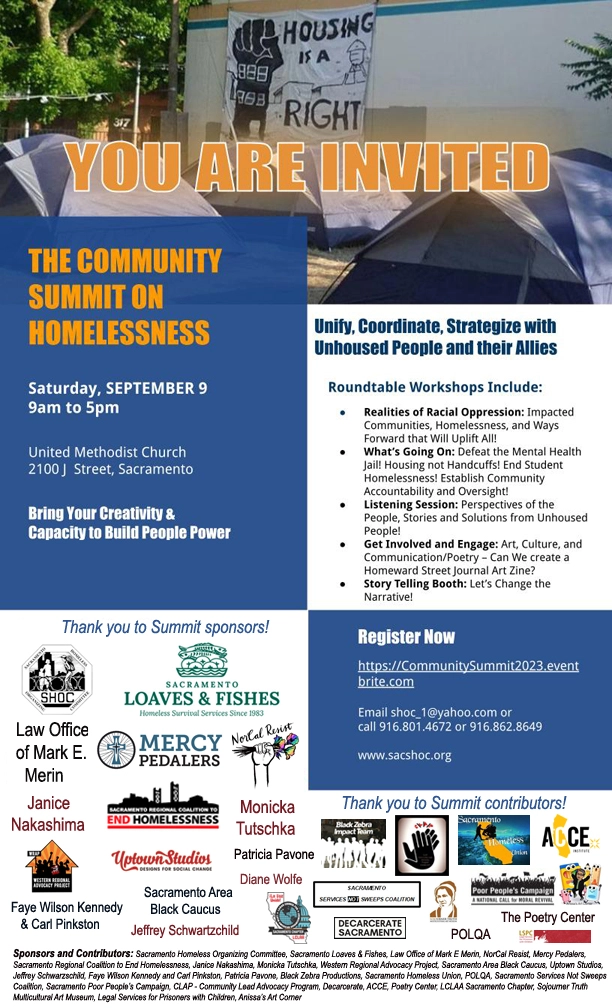
Sacramento Turns Out for The Community Summit On Homelessness
“You do not have to be me in order for us to fight alongside each other. I do not have to be you to recognize that our wars are the same.” Audre Lorde, Sister Outsider: Essays and Speeches – Quote courtesy of Zuri K. Colbert, CLAP
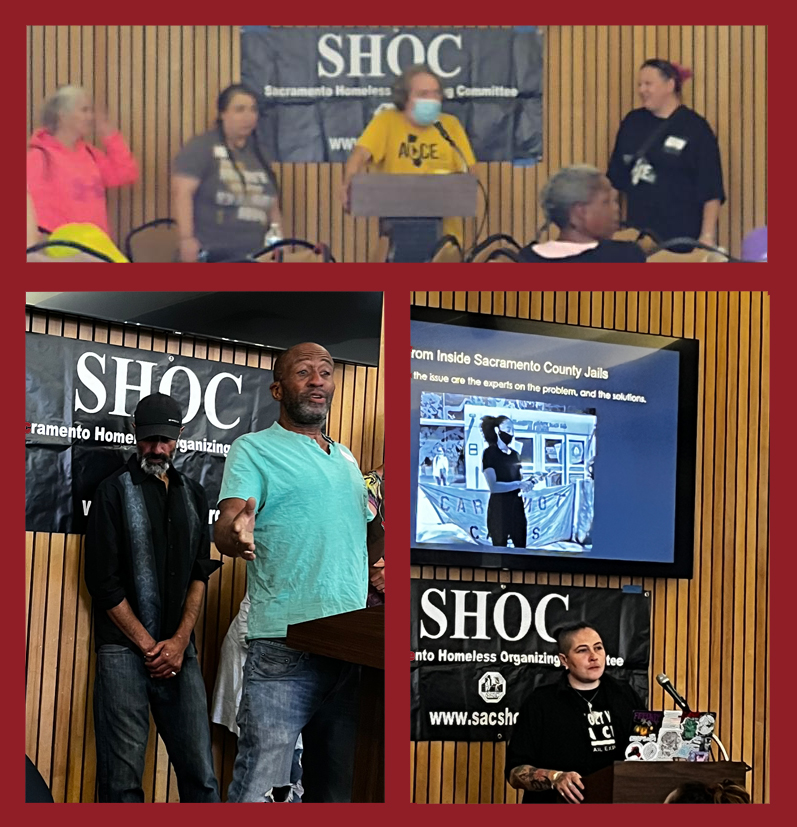
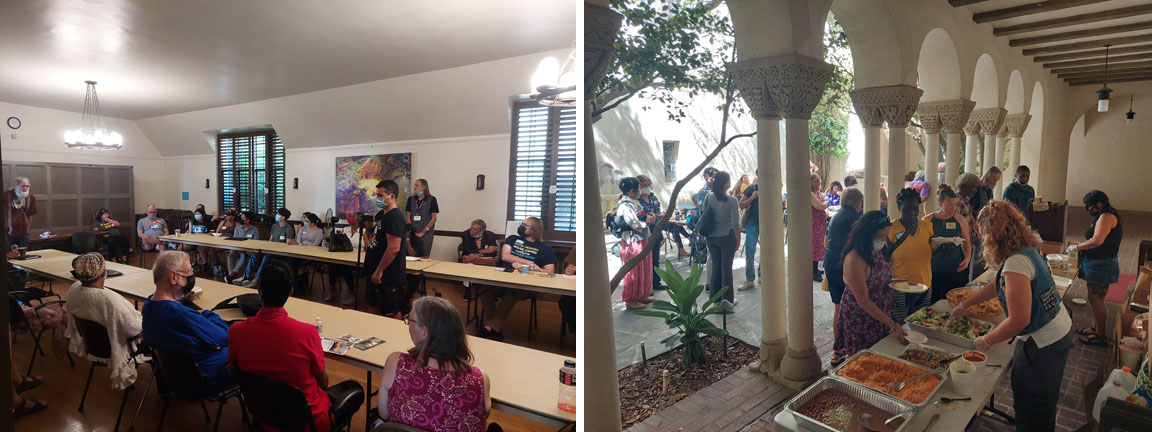
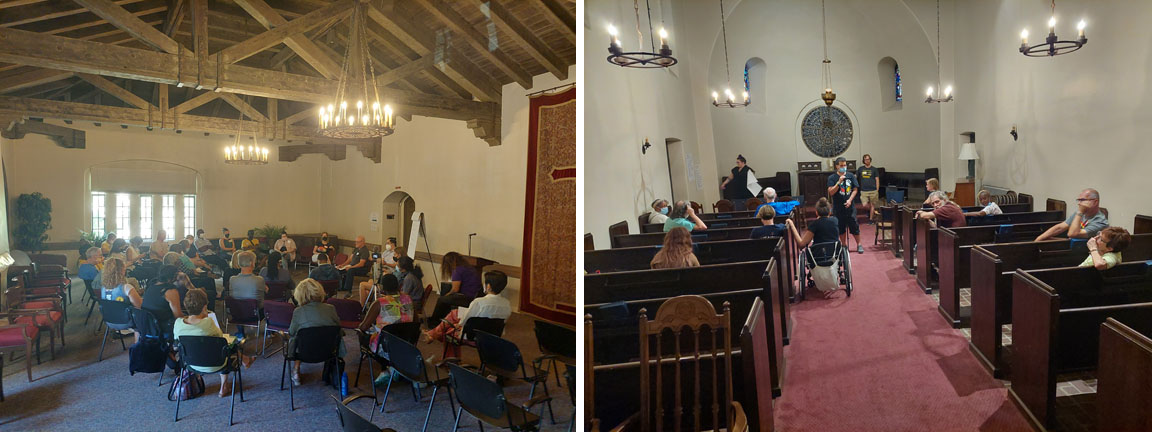
What a day! The Second Annual Community Summit on Homelessness, which the Sacramento Homeless Organizing Committee hosted on September 9 2023, at the spacious and welcoming First United Methodist Church in downtown Sacramento, deepened and expanded the connections between advocates, activists, unhoused leaders, dreamers, fighters, and thinkers for housing justice! As the SHOC member Bobbie Ramey-Clark said in her welcome address,
“We are here today to build our unity and people power, our vision of housing justice to uplift and educate each other. We are building on the lessons of last year’s summit, and especially the need to organize and stay connected.”
The Organizations – A Representative Sample
Dozens of organizations sent their members and representatives to this energetic assembly of friends and allies – here’s a few of the organizations that gave the day energy and direction.
Public Health Advocates (PHA), a statewide organization that brings a public health lens to today’s most pressing problems, helps communities to pass laws, reform systems, and establish norms that foster justice, equity, and health.
Community Lead Advocacy Program, (CLAP) was formed due to the lack of equity, resources, and representation for marginalized Sacramento communities. CLAP provides community reach-ups, viable resource links, Black hygiene living supplies, and community connection for Sacramento.
Sojourner Truth African American History Museum — The mission of the museum is to open minds and change lives through the exploration of African American history, experiences, and culture through art education and outreach. The museum offers resources to document, preserve and educate the public on the history, life and culture of African Americans.
Legal Services for Prisoners with Children (LSPC) LSPC organizes communities impacted by the criminal justice system and advocates to release incarcerated people, to restore human and civil rights, and to reunify families and communities. LSPC build public awareness of structural racism in policing, the courts, and the prison system, and we advance racial and gender justice in all our work.
Alliance of Californians for Community Empowerment (ACCE) – In Sacramento, ACCE is playing a critical role in voter outreach to build a progressive voting base and is fighting for the human right to housing and stronger tenant protections.
Sacramento Poor People’s Campaign – A National Call for Moral Revival (Sacramento PPC) – The campaign is uniting people across California to challenge the evils of systemic racism, poverty, the war economy, ecological devastation and the nation’s distorted morality of religious nationalism.
Camp Resolution – Camp Resolution is a local self-governing encampment of unhoused people organized to provide a safe place to live and to advance the right to housing for residents and for the community as a whole.
Safe Ground Sacramento advocates for the decriminalization of homelessness and establishment of Safe Ground communities where those who are homeless may reside until they may obtain housing.
The Plenaries
The Community Summit featured three plenary sessions, where all attendees gathered together before separating into break-out sessions for networking and strategizing.
The first plenary, “The Realities of Racial Oppression” was presented by Zuri K. Colbert from CLAP, Sister Brenda from The Center on Race, Immigration, and Social Justice (CRISJ), and Harpreet Chima of the Labor Council for Latin American Advancement (LCLAA). The session focused on Black, Brown, and Indigenous communities. The circumstances that lead Black, Brown, Indigenous people to disproportionately experience homelessness cannot be untangled from the impact of institutional and structural racism in education, criminal justice, housing, employment, healthcare, and access to opportunities.
The second plenary, “What’s Going On,” focused on the police attacks on homeless encampments, displacing residents and confiscating property, and the housing crisis, highlighting the opportunities we have to organize and develop links with unhoused residents. Khanstoshea Zingapan from Black Zebra Impact Team and Niki Jones from SHOC presented, along with JKatt from the Island encampment. The session featured a heart-breaking documentary film made by Black Zebra, showing the mechanized claw used by the City breaking up tents and destroying survival gear as a resident weeps at the destruction and loss.
The Third Plenary, “Next Steps,” led to work groups that discussed ways to incorporate the energy of the day into legislation and lobbying, a group discussion on self-run outdoor communities, and a group discussing how to begin organizing for the publication of a Homeward Art Zine – a new format for Homeward Street Journal that can be distributed to encampments and sold by vendors citywide.
Other activities during the event included POLQA and Black Zebra hosting a Story Booth that will produce a video of the voices of those impacted by homelessness, and also Anissa’s Art Corner provided art activities.
Perhaps the most important gathering in the course of the day was the Listening Session that brought together residents of encampments in Sacramento and Oakland to discuss their solutions to homelessness, expressing the empowerment that is rooted in community and self-governance for encampments.
What a day! We are already planning for next year’s Community Summit, broadening the coalition that will host the event and envisioning how the Sacramento community can unite around the housing crisis and bring our unhoused residents home – the place where they belong.
We are sad to share a deep loss to SHOC and Homeward that Lee Parks passed away unexpectedly earlier this month. Lee has volunteered with SHOC and Homeward Street Journal since 1997, and served as editor and layout person for Homeward, exclusively, since the early 2000’s. He also volunteered in the office overseeing the distributor program.
Loaves & Fishes will include him in their group memorial on March 29 at 10AM in Friendship Park.
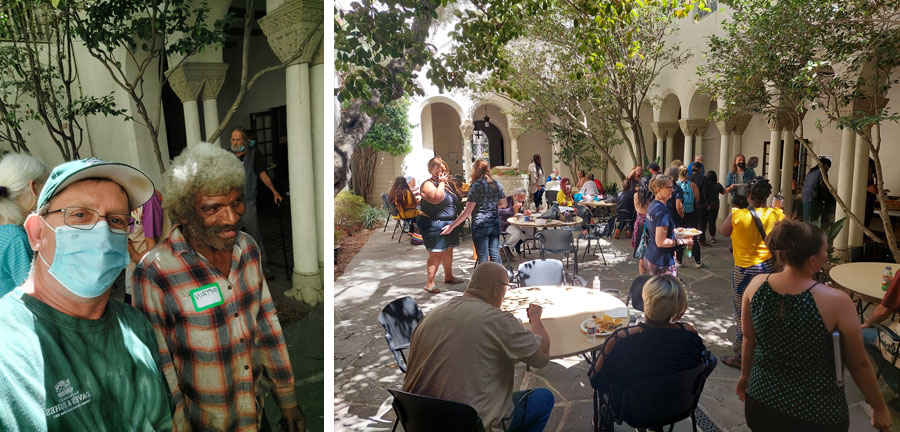
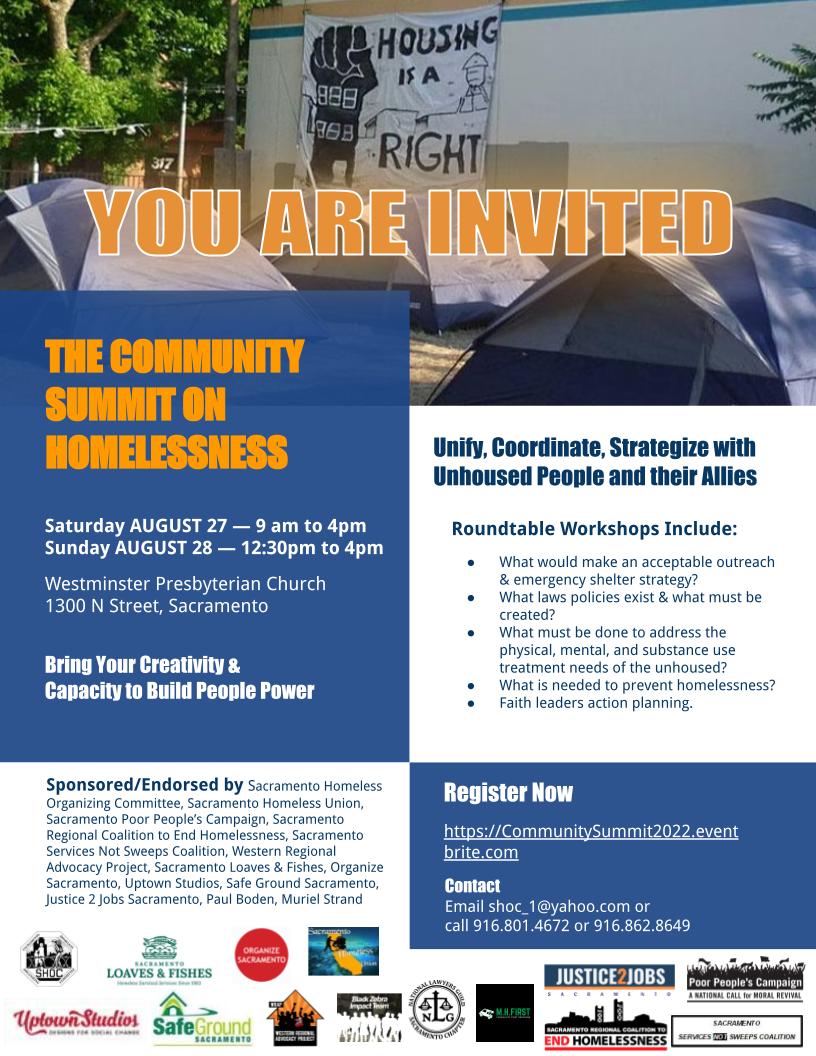
by Cathleen Williams. Sacramento’s Community Summit on Homelessness convened on August 27th and 28th of this year. On a magnificent summer weekend, at Westminster Presbyterian Church, a hundred-year-old brick church across from the great trees of Capitol Park, a range of organizations, through their movers and shakers, gathered to start strategic planning around the moral, political, and practical crisis of homelessness.
Emergency Shelter Strategies Roundtable Workshop Lunch from Vallejo’s served by Punks for Lunch
The Setting of the Summit
Outside the walls of this peaceful site, the relentless and brutal assault by police, code enforcers, park rangers, CalTrans workers, and Sheriff’s deputies against unhoused people continued to rage throughout our city and county as our elected representatives pushed forward with their own drastic “non-solution,” towing vehicles, wrecking tents and encampments, displacing unhoused neighbors who live on sidewalks and grassy medians, in parks and open lands – all this suffering and hardship inflicted upon people in dire poverty, all this inflicted without a plan, an actual plan, to house or even shelter a community numbering between 10,000 and 20,000 people (the lower figure estimated by the official homeless “point in time” count of January 2022)
Meanwhile, new and hostile legal offensives are being cooked up at every level – by the State, funding CalTrans’ with hundreds of millions to clear land around highways from inhabitants; by the City, with new bans on sidewalk stays; and by the County, outlawing unhoused people from so called “infra-structure” areas that just happen to cover every corner and crevice of the 900 square mile expanse of Sacramento County.
And with these laws, an ugly narrative is being broadcast, accusing unhoused people of being violent, criminal, and distasteful – pariahs who should not be seen by children on their way to school or by the “good citizens” who should be able to shop, play and work without being confronted by the social devastation that is our country at the present moment.
Perhaps the most blatant new legal assault is Measure O, which the City has placed on the November ballot. Opposed by two insightful city council members, Katie Valenzuela and Mai Vang, this Measure will mandate the city police to remove homeless people from their living areas in a vast campaign of sweeps and clearances, while authorizing only 600 “spaces” where they can legally live – most likely in city run encampments rather than places where they will be inside, with a door that closes and windows that open.
All this police action – Measure O provides that failure to homeless people to comply will be punishable as a misdemeanor, leading to jail and fines – is clearly an attempt to avoid the impact of the federal decision in “Martin v. Boise,” which held that criminalization of homeless people for living outside was unconstitutional “cruel and unusual” punishment unless each and every person had access to indoor shelter. Already taken to court for putting this on the ballot, the city will face strong legal challenges to this wasteful, expensive, futile, cruel ordinance.
The Summit thus opened against the background of a dire situation, one that could not be “solved” over a period of 2 days even with the best intentions, and even with the involvement and guidance of unhoused attendees, many active in the Homeless Union and other local organizations, and committed to developing awareness and political power. According to attendee Janeen Kemp, who just emerged from a stint of homelessness, never to return, “I don’t want to just keep talking. I don’t believe that anything is coming from our current government. They are taking public funds without the public knowing how it is being spent. People are making money from our problems. We are one of the richest states in the nation and the richest cities in the state. We need to have more power and influence in making our demands.”
Law & Policy Roundtable Workshop Housing and Homelessness Prevention Workshop
The Keynote Address
Niki Jones, keynote speaker, opened the Summit with a powerful land acknowledgement. “We hold this summit on stolen indigenous land, Valley Miwok and Nisenan land. Settler colonialism, the theft of land, is still the structure of our society.
“In our conversations here, we must address the reality of the white supremacist rule. Not far from this spot stands Sutter’s Fort – the first recorded encampment after the initial removal of local indigenous people. Sutter cleared those people out. It’s a racist, ablist practice, harkens back to Jim Crow. The move to “clean up” or remove people, — what unhoused people are experiencing today — is an old system and an old strategy.”
As Niki enjoined us, “we have a world to fight for. Care and feel the pain in caring. Share what we need…family, neighborhood, organization. Learn to lean into survival strategies, up lift where people are. This is war and these are the front lines. We practice solidarity, not just charity.”
The Roundtable Workshops
On Saturday, community summit roundtable workshops were organized around themes of empowerment in the struggle against homelessness.
Acceptable Emergency Housing Strategies,” coordinated by Crystal Sanchez of the Homeless Union and, addressed how to reshape the endless cycling of unhoused people through the shelter system, including mass shelters, city provided encampments, and motel rooms, a system in which short term stays, lack of privacy and dignity, and arbitrary mismanagement is the norm. Enormously expensive and yet desperately inadequate – the central question discussed was how to make the city and county accountable for the horrendous abuses, and how to shift resources to housing instead of short-term shelter.
Two roundtable workshops, dealt with Law and Policy, the first one focusing on criminalization, sweeps and advocacy, coordinated by Bob Erlenbusch of SRCEH and Laurance Lee of Legal Services, and the second, on legal rights, litigation, and legislation, coordinated by Mark Merin. Participants tackled the question of how to organize and block the new ordinances that outlaw encampments, and how to file lawsuits in federal court challenging the sweeps, displacements, and loss of property as unconstitutional under Martin v. Boise.
Dr. MK, from UC Davis Family Medicine and Sacramento Street Medicine, and Flojuane Cofer of Public Health Advocates, led the roundtable workshop “What the Health,” focusing on how to improve and expand medical care by taking services out to encampments and making them accessible and friendly to the people most in need. Innovation and outreach was the emphasis of the day.
The roundtable workshop on “Housing and Homelessness Prevention” brought in the Sacramento Tenants Union and Peter Bell of Sacramento Steps Forward to lead the discussion about the impact of a private, profit-driven housing market, looking at ways to preserve, fund, and build public housing to deal with the crisis.
The Take Aways
Throughout the Community Summit, we put the emphasis on solutions – as unhoused people, visionaries, activists – each and every roundtable workshop addressed the question of how can we come together to reimagine and bring about the changes we need to see.
As we work on follow through, these are the major themes that emerged in group discussions:
Organize, organize, organize. Bring organizations together, outreach to new communities, involve unhoused people with trainings and strategic planning; prioritize work with the Homeless Union and other unhoused leaders to establish a commission of homeless people and their allies to oversee public policies.
Get the facts and information we need to drive our policy demands and audit public expenditure – how are funds being spent, who is responsible, and what are their goals as compared to ours? How can we hold accountable the powers that be?
Defeat Measure O – raise consciousness, raise funds, get out the vote, and fight the narrative that stigmatizes and stereotypes homeless people as criminals, deviants, and pariahs.
Remake the system of short-term stays at temporary shelters and city-run encampments — but overall prioritize a campaign to build, build, build public housing while supporting informal, self-initiated and self-governed living spaces with health services, survival necessities, garbage pick-up and sanitation.
Stop criminalization of people living outside – through litigation if necessary – and publicize the trauma and devastation caused by using sweeps and zoning enforcement to break up informal encampments, confiscate belongings, and displace homeless people.
We are working toward a full report on the recommendations that were developed at the Community Summit and we are making contact with the dozens of people who attended – almost a hundred over the two days, including 28 people who came from their encampments and tents and brought their perspectives, their experience, and their wisdom.
Joe and Captain Lunch in the Courtyard
Acknowledgements
A Special Thank You to Westminster Presbyterian Church and to Community Summit Sponsors: Sacramento Loaves & Fishes; Safe Ground Sacramento; Western Regional Advocacy Project; Organize Sacramento; Uptown Studios; Paul Boden; Muriel Strand
And thank you to the contributions of the many participating groups, including but not limited to: 28 individuals that are living unhoused in Sacramento; Black Zebra Project; David Barnitz (Westminster Presbyterian Church Deacon); Decarcerate Sacramento; Interfaith Council of Greater Sacramento; Justice 2 Jobs Sacramento; League of Women’s Voters, Homeless Committee; Legal Services of Northern CA; Mark Merin (Law Office of Mark E Merin); Mental Health First; National Lawyers Guild; No on Measure O; People’s Budget Sacramento; Peter Bell (Sacramento Steps Forward); Public Health Advocates; Punks for Lunch; Rebekah Turnbaugh (St. John’s Lutheran Church); Sacramento Area Congregations Together; Sacramento Homeless Organizing Committee; Sacramento Homeless Union; Sacramento Poor People’s Campaign: A National Campaign for Moral Revival; Sacramento Regional Coalition to End Homelessness; Sacramento Street Medicine; Sacramento Services Not Sweeps Coalition; Sacramento Tenants Union; Tim Brown (SHOC founder & SRCEH); UC Davis Willow Clinic; Women’s Empowerment
The SHOC office is closed all this week (September 5 – 9) due to the extreme heat. We don’t have new papers in yet anyway. New issue of Homeward Street Journal will be available next Thursday, September 15.





 SHOC
SHOC 